
Automate Hotel Reporting With AI
A global hotel software provider asked Antematter to help its customers automate hotel reporting with AI. Those customers (boutique hotels, luxury lodges, and adventure hospitality operators across 35 countries) waited more than three weeks for every manual reporting cycle. After the build, the same answers arrived in under 24 hours. They came from the PMS database, pulled out in response to plain-English questions. This page is written for two readers: hotel operators who want faster reports, and software companies that want to embed AI in property management software of their own.
The Client
The client sells property management software to the hospitality industry. Its customers run boutique hotels, luxury lodges, and adventure hospitality operations in 35 countries. Every customer stores reservations, rates, and guest records in the same uniform schema: one shared database design across all properties.
That uniform schema was the client's greatest asset and its biggest obstacle. The data was consistent and ready. But it stayed out of reach behind complex SQL queries and manual Excel compilation, so most users waited on analysts.
Growth made the wait expensive. Executives wanted answers at the speed of the market. The software had the data. It lacked a way for ordinary staff to ask for it.
The Problem: Hotel Reporting Cycles That Took Three Weeks
Every reporting cycle ran beyond three weeks. Operations teams spent upwards of 20 days per cycle aggregating performance data across properties, then stitching together fragmented reports that reached executives too late to guide pricing, staffing, or competitive positioning.
Decision-makers were always reacting. They studied last month's occupancy trends while competitors adjusted rates in real time based on market signals.
The fix had to be built inside the product. An external dashboard or analyst service would not scale across a global customer base. The client needed natural language reporting for hotels, built into the PMS itself. So that is what Antematter built.
The Solution: Two Ways to Automate Hotel Reporting With AI
Antematter built an AI copilot for hotel PMS users directly into the client's interface, turning a traditional transactional database into a hospitality business intelligence layer. The copilot appears as a persistent chat window on every operational screen, from front-desk check-in to the executive dashboard. Staff type business questions in plain English. The system queries the MySQL schema, runs the analysis, and returns the answer with a transparent reasoning trail: a visible record of which data informed the result.
The copilot answers in two ways:
-
Query Templates
For recurring reports: monthly performance reviews, competitive positioning assessments, occupancy forecasting across properties. A team picks a pre-configured query such as "Compare Q3 revenue performance across all properties against regional competitors" and gets an answer within seconds. No data gathering, no cross-referencing, and no waiting on analysts.
-
Agentic Search
For exploratory questions that no template covers. Instead of matching one stored report, the system runs a short chain of steps (find the right tables, run the queries, join the results) and then shows every step it took.
-
Data From Inside and Outside
The system combines internal operational data with external intelligence streams. Ask about comparative performance and it does not stop at an occupancy percentage. It shows whether underperformance stems from internal or external factors.
-
One Entry Point for Every Role
Front-desk staff ask about the day's agenda logistics. Revenue managers explore pricing scenarios. Executive teams request comparative analyses. Same chat window, business language, zero database terminology.
A question like "Why did Group A spend less on activities than Group B despite similar demographics?" shows the depth. The system splits the question into steps, joins reservation records, POS data, and guest preference histories, and shows its approach before it answers. Operators see the reasoning. That transparency is why they trust the numbers.
Architecture
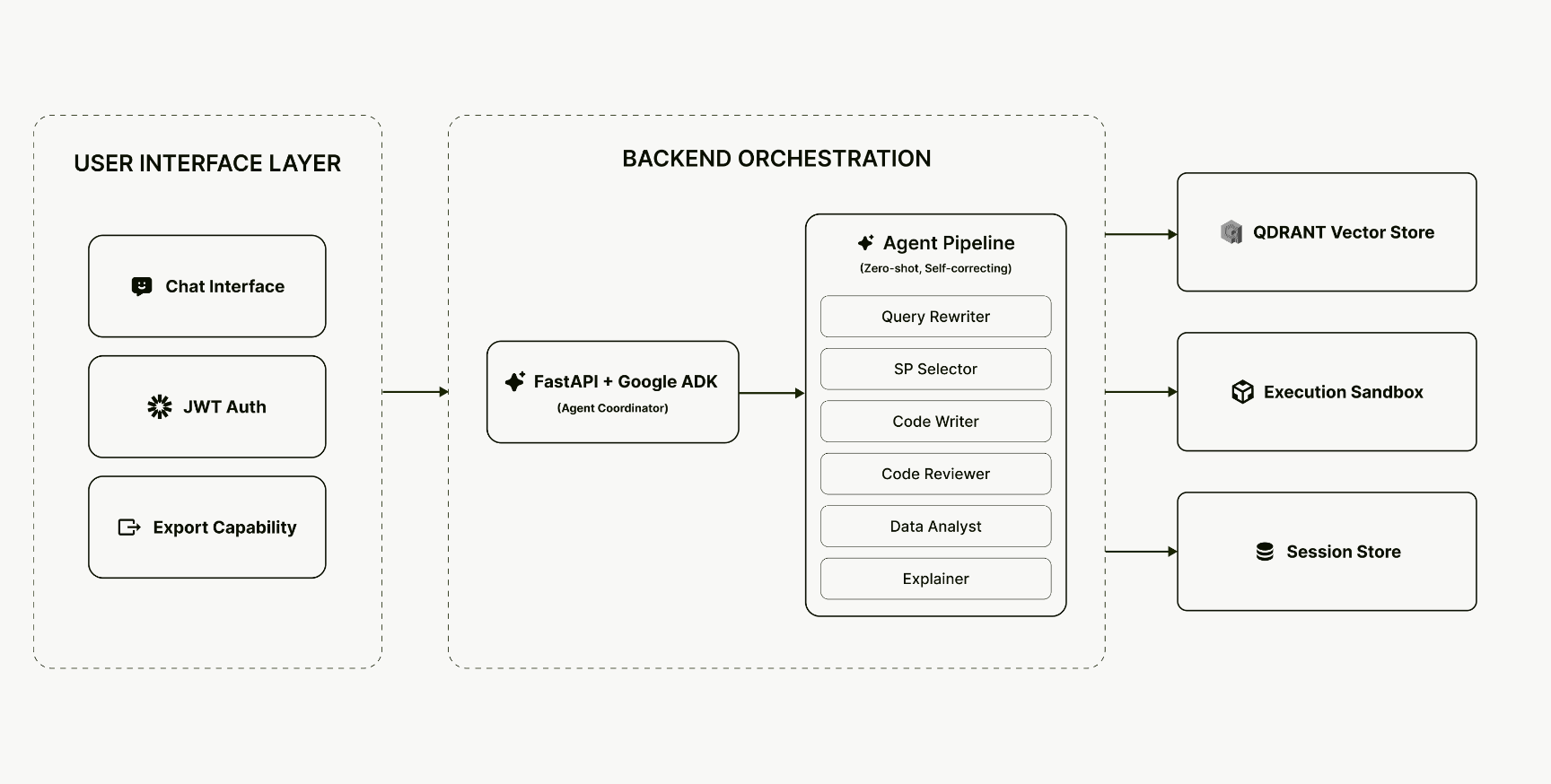
The stack under the copilot. Every piece exists to keep answers fast, cheap, and correct, which is why each line matters to the buyer.
-
AI Models
GPT-5 Mini does the code synthesis; it writes the queries. Gemini 2.5 Flash does the contextual reasoning. Zero-shot agent orchestration means no task-specific training: the models follow instructions out of the box.
-
Self-Correction
Bounded iteration loops with automated validation. If a generated query fails, the system checks it and retries within set limits. It never loops forever.
-
Vector Retrieval
A Qdrant vector database, with OpenAI text-embedding-3-large embeddings, narrows 15+ stored procedures to 3-5 relevant candidates per query. That is a 60-70% token reduction versus preloading the full schema: lower cost per question, faster answers.
-
Backend
FastAPI with Google ADK (Google's agent toolkit) on an asyncio execution sandbox, so agent steps run in isolation without blocking each other.
-
Frontend
React/Vite with WebSocket streaming. Answers stream onto the screen while the system computes them.
-
Deployment
Docker containerization with automated RAG ingestion on startup. At every boot, the system reads fresh documents into its knowledge base on its own.
The Outcome
Reporting cycles dropped from more than three weeks of manual work to under 24 hours. Recurring template queries now return answers in seconds. Vector retrieval cut token costs by 60-70% versus full-schema preloading.
Managers now adjust strategy while the opportunity is still live. The hours that operations teams once spent compiling data go to analysis and guest engagement instead. As usage grows, the copilot will handle more of the reporting work that analysts once did manually.
Frequently Asked Questions
How do you automate hotel reporting?
You connect a natural-language layer to the PMS database. Recurring reports run through query templates, and one-off questions go to agentic search. Staff ask in plain English and get answers in seconds, with the reasoning shown. That is hotel reporting automation end to end.
Can AI answer questions about my hotel data?
Yes, in plain English. The system writes and joins the queries across reservations, POS records, and guest preference histories. Each answer comes with a trail that shows which data informed it: an AI assistant for hotel data queries, not a black box.
What is agentic search?
Instead of matching one stored report, the system runs a short chain of steps: find the right tables, run the queries, join the results. That chain lets it answer questions no template covers, and the reasoning trail shows every step it took.
Explore Other Case StudiesEnsuring Global AI‑Readiness

Subscribe to the Antedote
Get advice on how to leverage AI to make your processes leaner and cost-effective.