AI Agent for Email Booking Automation
A global chauffeur company asked Antematter to build an AI agent for email booking automation, and the system changed how it operates: 90% of bookings now get created with no human touch, first-response times fell from 1.5+ hours to under 10 minutes, initial booking errors dropped 92%, and staff recovered 25+ hours per week of manual work. The client serves executives and VIPs in 40+ countries. This page shows what was built, and how any operations team that takes bookings by email can use the same approach.
The Client
Our client is a top name in transportation and logistics. It has served over 60% of Fortune 100 companies and built a strong reputation for efficient, high-quality black car service in major cities worldwide.
The footprint is global: 350+ service areas spread across the financial hubs of 40+ countries: North and South America, Europe, Africa, the Middle East, Asia, and Australia. The company employs over 7,000 chauffeurs and generates more than $50 million in annual revenue.
Then demand exceeded what the process could handle. Growth exposed major bottlenecks in delivery time, and the client had to remove them fast before scale made the losses worse.

The Problem: Every Booking Started as an Email, Read by Hand
Most bookings arrived as unstructured email. A person read each message, copied out the details, and typed the booking into the platform by hand. Three costs piled up:
- Processing delays. Interpreting customer emails and generating bookings on the underlying platform was slow, manual work that grew with every new client.
- Incomplete information. Wrong or missing details slipped past the manual checks and delayed bookings at later stages of the process.
- Wasted staff time. Repetitive triage took up the hours of the very people who should have been serving special-needs clients.
The more the company grew, the deeper the backlog. First replies to customers stretched past 1.5 hours.
The Solution: An AI Agent for Email Booking Automation
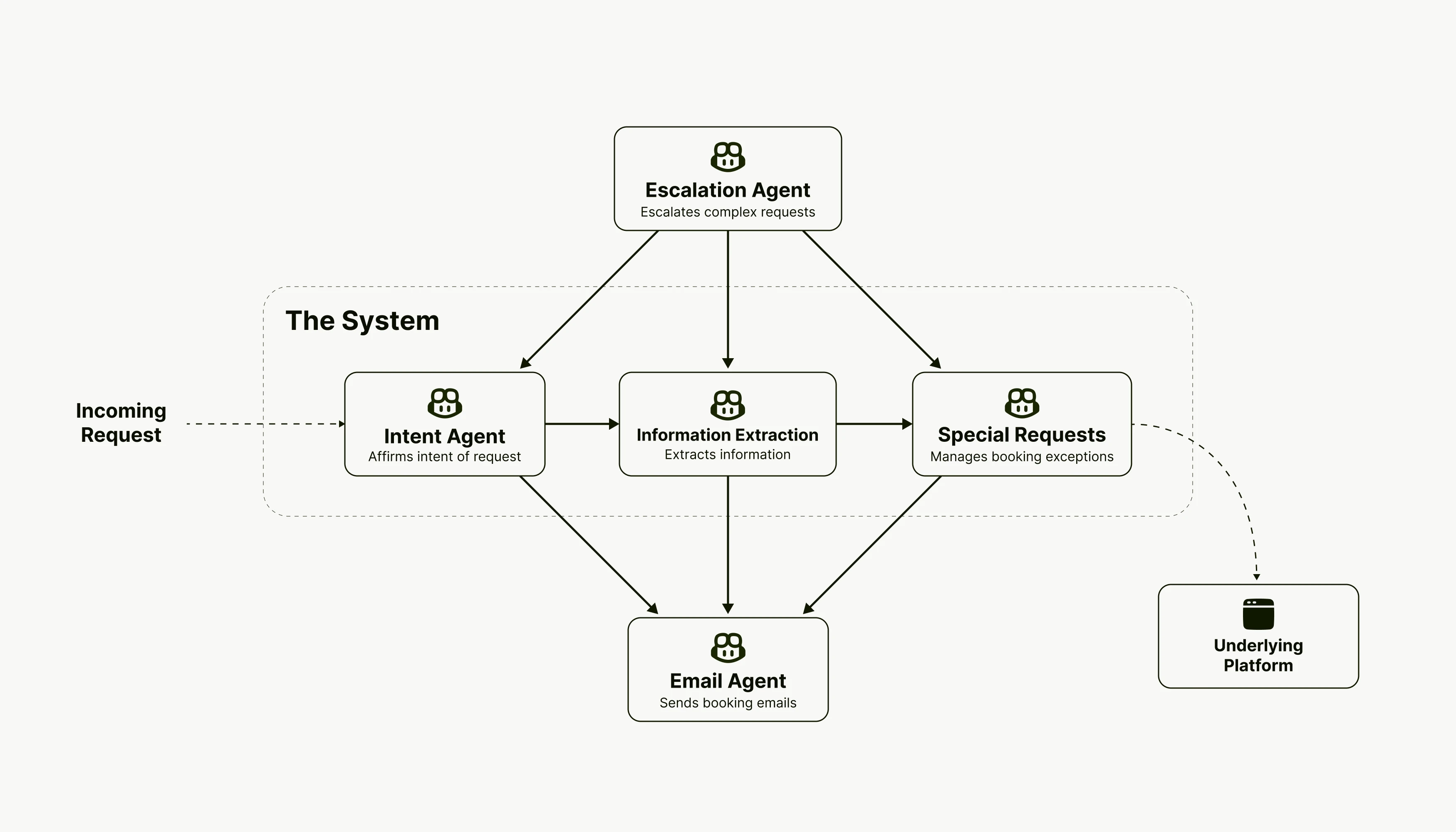
Antematter built a multi-agent email response system with direct integrations into the client's booking platform. Every inbound email now goes through the same five checks, in order:
-
Intent Classifier
The first model labels each email: booking request, or not. This is AI intent classification for inbound email. Spam and noise never enter the workflow.
-
Initial Request Classifier
This check has one job: can the system handle this request at all, or does it need a person? Out-of-scope cases route to staff immediately.
-
Information Extractor
The system parses each email and extracts the relevant data (dates, pickup and drop-off details, special requests) in the exact format the next stage needs.
-
Special Request Overseer
Some bookings include special requests that add real complexity. This check separates the ones the system can complete from the ones that require human involvement.
-
Email Handler
The system sends and replies to email on its own: it asks for missing information, confirms booking status to the customer, and contacts the dedicated human team when a case escalates.
Along the way, the system validates data and registers bookings inside the client's own platform, through its private APIs. The dispatch workflow stays untouched. People keep the complex cases; the system takes the repetition.
Architecture
The client asked for a lean, code-minimal system that would respect its existing quality and data-privacy requirements. The stack meets both:
-
n8n Orchestration
n8n is a workflow automation tool that wires systems together without heavy custom code. It moves every email through the agent chain and into the dispatch workflow.
-
OpenAI Models via OpenRouter
The language models are the latest OpenAI models, reached through OpenRouter. One access point keeps model choice flexible as performance improves.
-
Private Booking-Platform APIs
The agents read and write directly in the client's booking platform through its private APIs. Validation and booking registration happen where the data is already stored.
-
Human-in-the-Loop Escalation
When a classifier or the special-request check flags a case, the workflow hands it to the human team with the extracted context attached. People review a summary, not a blank inbox.
The Outcome
The system went live and the results were immediate:
- Bookings automated: 90% of email bookings created with no human touch.
- First-response time: from 1.5+ hours down to under 10 minutes.
- Initial booking error rate: down 92%, driven by automated extraction and on-time flagging.
- Email analysis and information extraction: 15+ hours per week saved.
- Automated booking creation: 10+ hours per week saved on top of that.
In total, staff recovered 25+ hours per week. The client kept its delivery metrics and improved them, and the team moved from inbox triage to operations and personalized service for high-value clients. As the company expands globally, it will rely on this system to absorb the next wave of demand, and the bottlenecks that come with it.
Frequently Asked Questions
Can AI handle booking emails automatically?
Yes. The system classifies the intent, extracts the dates, addresses, and special requests, creates the booking in the dispatch platform, and escalates only complex cases to staff. This client automated 90% of its bookings this way.
What happens when an email is too complex for AI?
The system flags it and routes it to the human team with the extracted context attached. Special requests and edge cases stay with people. Staff start from a summary, not from a blank inbox.
What is AI intent classification for email?
It is the first-pass model that labels each inbound message (booking, change, question, spam) so only genuine requests enter the workflow. Everything else gets filtered out before it costs your team time.
Explore Other Case StudiesEnsuring Global AI‑Readiness


Subscribe to the Antedote
Get advice on how to leverage AI to make your processes leaner and cost-effective.