
Automate RFP Responses With AI Agents
Antematter helped an EHS compliance firm automate RFP responses with AI agents and cut proposal turnaround from 32 hours to 10-15 minutes. The client, a regulatory compliance consultancy, serves major brands across America and Europe. Every major bid arrived as a formal questionnaire, and every questionnaire took days of expert time. A self-hosted platform, grounded in a 6,000-node knowledge graph, now drafts those answers and the bid team prepares proposals the same day.
The Client
Our client is an EHS (environmental health and safety) regulatory compliance firm. The firm serves major brands across America and Europe.
Two teams were involved in this engagement. The sales team supports clients in 11 languages across Asia-Pacific, Europe, and Latin America. The Solutions Engineering team answers the RFPs.
Antematter delivered two systems here. This case study leads with the first: AI RFP response automation for the bid team. The second, a real-time translation system for sales calls, follows in its own section below.

The Problem: Why RFP Responses Took 32 Hours
Each RFP contained 50-100 technical questions. The answers sat in different departments, in different formats. One proposal took up to 32 hours of manual, cross-departmental work.
The cost was structural. That pace capped how many opportunities the team could pursue at once, and coordination, not knowledge, was the bottleneck. The experts had the answers. The process made them slow to gather.
So the goal became cutting RFP response time: keep experts in control, cut the manual work, and answer more bids with the same team.
The Solution: Automate RFP Responses With AI Agents
The question was how to automate RFP responses without losing expert control. Antematter answered with a self-hosted platform built on fine-tuned open-source models, complete data privacy controls, and a human review step on every draft.
-
Question Extraction
Each RFP file goes in, and Qwen2.5-7B models pull out the technical questions. No manual sorting. No hours of copy-paste.
-
Grounded Retrieval
FAISS vector search (an open-source engine that matches new questions against stored content) queries an AI knowledge graph for RFP answers: 6,000 nodes of the client's own material. The graph works like a response library, so every answer traces back to an approved source.
-
Fast, Grounded Generation
Drafts come from Retrieval-Augmented Generation (RAG), which fetches the source text first and then writes, combined with Cache-Augmented Generation (CAG), which caches that context so repeat queries skip the fetch. Antematter applied Chain-of-Thought (step-by-step reasoning) and Monte-Carlo simulation techniques to keep inference fast and the answers grounded.
-
SME Review in the Loop
Nothing ships without a person. Subject-matter experts (SMEs) review and edit drafts in the platform, with real-time collaboration across departments. Authentication is done through Okta single sign-on (SSO). Access to view, edit, or approve each answer is set by role-based access control (RBAC).
-
Prompt-First Design
The platform runs on a prompt-first architecture rather than agent-heavy orchestration. Fewer moving parts. Simpler automation to maintain and audit.
Architecture
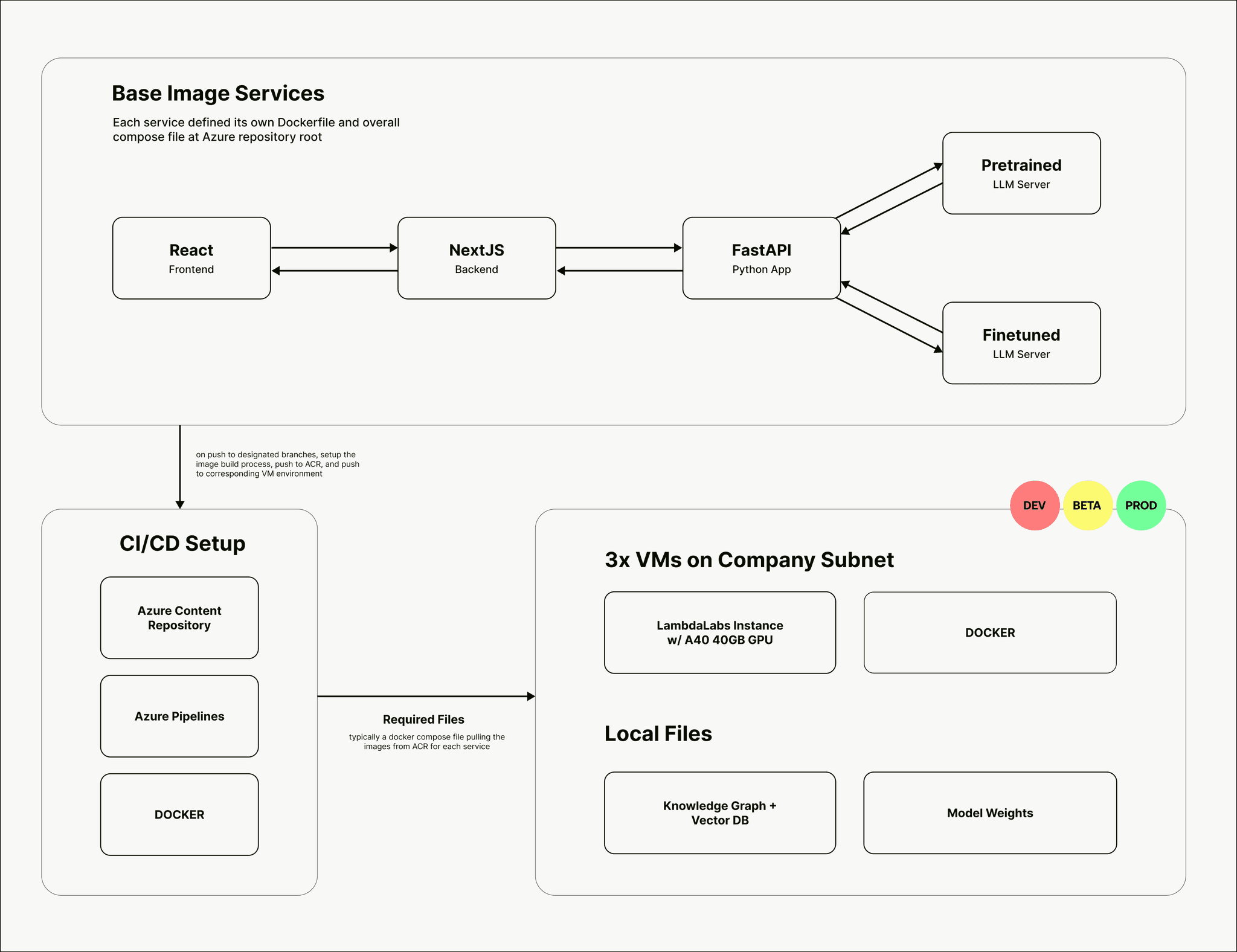
For teams weighing a self-hosted LLM for proposals, here is the full stack. Every layer runs on GPU instances the client controls:
-
Self-Hosted GPUs
The models serve one client, on three LambdaLabs A40 GPU instances split into DEV, BETA, and PROD environments. No proposal data flows to a public AI API.
-
Separated Service Layers
Frontend UI, request management, and a Python LLM API layer run as separate tiers. Every call routes through the backend to two llama.cpp servers, a lightweight engine for running Qwen2.5 models in production.
-
FAISS Query Speed
FAISS returns matches in under 600 milliseconds, against the retained knowledge graph. Fast queries keep the review loop moving, and because the graph holds only approved material, the answers stay compliant.
-
Azure CI/CD
Version control and deployment automation run through Azure CI/CD pipelines, so every release follows the same tested path across environments.
A Second System: Real-Time Translation for Sales Calls
The metrics above were measured on the RFP platform. The translation system is a separate build.
The client's sales team works in 11 languages across Asia-Pacific, Europe, and Latin America, markets where each country sets its own compliance rules. On live calls, reps lacked the local regulatory context they needed, so answers went out late. Follow-up after follow-up.
Antematter built a real-time translation (RTT) pipeline for those calls. Whisper-v3 does speech-to-text (STT), Qwen2.5-7B-Instruct runs bidirectional translation with contextual suggestions, and MeloTTS synthesizes the final audio. The sequential pipeline completes the round trip in under 3 seconds.
The original build hit deployment issues as delivered, so Antematter repurposed it into a centralized translation API. LiteLLM now routes requests to SambaNova's Qwen3-32B model, with pre-defined translation prompts that speed up generation. Developers across the client's tooling call the same API for text, audio, and image translation.
The Outcome
The RFP platform changed how the firm bids:
-
Response Time
32 hours → 10-15 minutes per proposal, a 95% reduction in the operational resources each RFP required.
-
Turnaround
A 4-day cycle became same-day delivery. The team now pursues concurrent opportunities instead of queueing them.
-
Expert Hours
The Solutions Engineering team saves 29-30 hours per proposal while holding the technical quality their clients expect.
-
Collaboration
RBAC and real-time editing removed the cross-departmental coordination bottleneck, with sub-600-millisecond queries keeping reviews moving.
Next, the firm will extend the automation to new document classes and to client-facing communication systems, and will scale its global compliance services without operational bottlenecks.
Frequently Asked Questions
How long does an RFP response take?
Done manually at this client: up to 32 hours per proposal, with 50-100 technical questions spread across departments. With the AI system: 10-15 minutes. Work that once took four days is now delivered the same day.
Can AI write RFP responses?
Yes, when the answers stay grounded. This system retrieves text from the client's own knowledge graph and document set, then drafts each answer for review. Subject-matter experts stay in the loop, so a human approves everything that goes out.
How do you keep RFP data private?
The deployment is self-hosted. The models run on the client's own LambdaLabs A40 GPU instances, every account is gated by Okta SSO and RBAC, and no RFP data leaves the client's infrastructure.
Explore Other Case StudiesEnsuring Global AI‑Readiness


Subscribe to the Antedote
Get advice on how to leverage AI to make your processes leaner and cost-effective.