
10DLC Campaign Registration in 60 Minutes
10DLC campaign registration automation turned a slow, expert-dependent paperwork slog into a single 60-minute session. The client, a major compliance automation firm, kept watching its customers stall in carrier queues for A2P 10DLC, the 10-digit long code system US carriers require for business texting. Antematter built the platform that fixes it: a conversational intake that validates every field, generates every artifact, and gets the filing accepted on the first submission.
The Client
The client is a major compliance automation firm. Its customers operate in the communications and marketing technology sector, where US business texting runs on A2P 10DLC: application-to-person messaging over 10-digit long codes.
US carriers (the MNOs, or mobile network operators) require every business to register before its traffic is trusted. The filing has two halves, and the 10DLC brand vs. campaign registration split is what confuses most first-time filers: brand registration establishes who sends the messages, and campaign registration covers what is sent, to whom, and why. Both pass through The Campaign Registry (TCR), the hub US carriers use for campaign vetting. Vetting also produces the 10DLC trust score that carriers use to manage each brand's traffic.
Done by hand, the process is slow, repetitive, and tied to rules that change constantly.
The Problem: Expert-Dependent Filings and Rejection Cycles
The A2P 10DLC registration requirements draw from three rulebooks: CTIA's messaging principles (CTIA is the US wireless industry's trade group), TCPA consent law, and each carrier's own policies. They change often. Keeping up demanded specialized compliance expertise.
Manual filings also fail. Incomplete submissions triggered rejection cycles, and rejection cycles stalled the firm's client onboarding pipelines. New customers waited on paperwork before a single campaign could go live, and every rejected filing went back to the same scarce experts.
The Solution: 10DLC Campaign Registration Automation
Antematter built a platform that automates 10DLC registration end to end and reduces the entire process to one guided session. A conversational AI assistant asks the questions in plain language, checks the answers against the rules as they arrive, and produces every compliance artifact the registry expects. Nothing is submitted until the filing passes CTIA, TCPA, and carrier-specific validation.
-
Conversational Intake
An AI assistant guides users through the mandatory registration requirements using natural language. It checks each answer on the spot and fills in the structured compliance forms itself.
-
Live Compliance Validation
The system validates every submission against CTIA, TCPA, and carrier-specific regulatory frameworks in real time. No manual regulatory research, and far less rejection risk.
-
Artifact Generation
The system produces every required deliverable: API-ready JSON payloads, formatted PDF documentation, and compliant static landing pages.
-
Registry Integration
Submissions are automated through direct API connectivity to the brand and campaign registries. No manual handoffs.
-
Compliance Copywriting
AI-generated suggestions for call-to-action text, Terms of Service, privacy policies, and sample messages: the items that usually require the most legal review.
A complete filing includes what the registry requires: business identity details such as an EIN, the messaging use case, sample messages, and proof of opt-in consent. TCPA compliance for business texting starts with that documented opt-in, and the filing has to show it.
Architecture
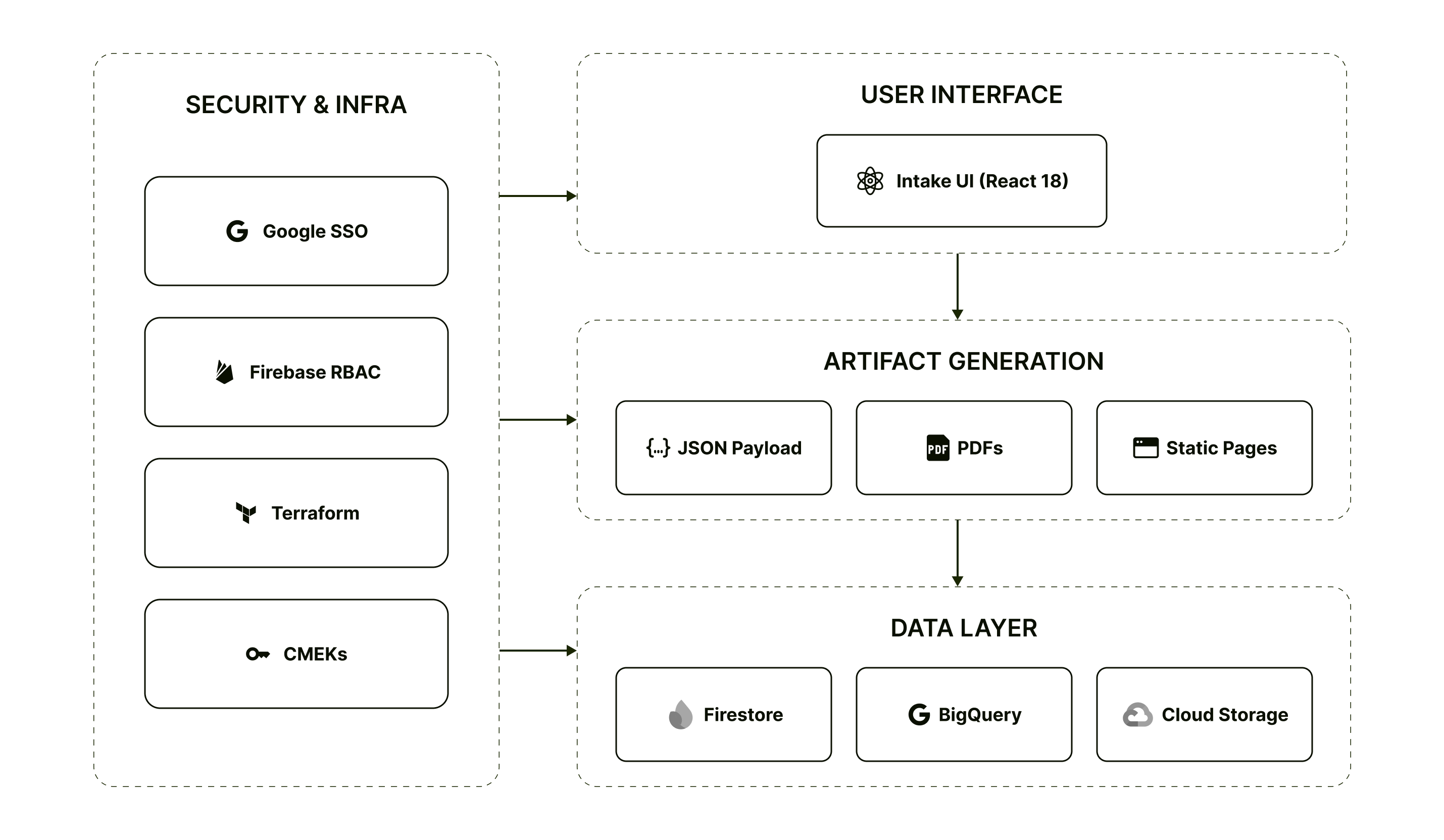
The platform runs on a microservices architecture on Google Cloud Platform (GCP), built for scale and security.
-
Core Services
FastAPI-based LLM orchestration with SSE streaming (server-sent events, the channel that streams replies into the browser) holds conversational latency under 2 seconds. A Python compliance engine runs hot-reloadable rules (rules that reload without a restart) delivered through Pub/Sub, so rule changes ship without a redeploy. A Node 20 registry adapter handles OAuth2 API integration with the registries. A React 18 intake interface supports dual-mode data entry.
-
Data Layer
Firestore stores real-time operational data. BigQuery keeps immutable audit logs, records no one can edit, on a 400-day retention schedule. Google Cloud Storage (GCS) holds compliance artifacts and static landing pages.
-
Security & Access
Sign-in is done through Google SSO with domain allow-lists. Role-based access control (RBAC) across customer, compliance officer, and admin roles is enforced with Firebase Custom Claims. Secret Manager stores credentials, and CMEK encryption (encryption keys the client controls) protects data at rest.
The request flow: a user works in the intake UI (React/Tailwind). Requests pass to the LLM orchestration layer (FastAPI), which calls the compliance engine (Python). Outputs move through the registry adapter (Node 20), document generation (Node 20), and the landing page builder (Next.js) before they are stored in Firestore and GCS.
The Outcome
- Manual, expert-dependent filings with rejection cycles → average registration completion in one guided session under 60 minutes.
- Rejection and resubmission cycles → registry acceptance on the first submission, which speeds campaign time-to-market and cuts compliance team overhead.
- Slow form-filling → a conversational intake that responds in under 2 seconds, keeping users engaged through data collection.
10DLC registration turned from a growth constraint into a competitive advantage. And when carriers change their rules, the team will push the updates through Pub/Sub, and every filing that follows will be checked against the new rules automatically.
Frequently Asked Questions
How long does 10DLC registration take?
Done manually, it is expert-dependent work: incomplete submissions bounce back, and teams resubmit through rejection cycles. The platform completes a campaign registration in one guided session under 60 minutes, validated before it is ever submitted. First-submission acceptance removes the resubmission wait entirely.
Why do 10DLC campaigns get rejected?
Most rejections trace back to incomplete filings, missing carrier-required fields, and sample messages that break CTIA or TCPA rules. The platform validates every submission against CTIA, TCPA, and carrier-specific requirements before it reaches the registry. Bad filings get fixed during the session, not after a rejection.
What is The Campaign Registry?
The Campaign Registry (TCR) is the hub US carriers use to vet A2P 10DLC brands and campaigns. Carriers rely on its vetting, and the trust score it produces, to manage business messaging on their networks. The platform submits to TCR directly through registry APIs, with no manual handoffs.
Explore Other Case StudiesEnsuring Global AI‑Readiness


Subscribe to the Antedote
Get advice on how to leverage AI to make your processes leaner and cost-effective.